
A vendor contract without enforcement teeth can leave you powerless to avoid a possible breach – not because of what you failed to detect, but because of what you had no contractual power to have fixed. Insurers investigating a vendor-caused breach can now ask whether you knew about the vulnerability and whether your contract let you force remediation; a “no” to the second question increasingly reads as negligence. Third parties now sit behind 30% of all breaches, according to Verizon’s 2025 Data Breach Investigations Report. This post breaks down the two-question test insurers apply to vendor-caused breaches, and what your supply chain contracts need to pass it.
Why is cyber insurance no longer a simple payout on premium?
Cyber insurers stopped treating a paid premium as sufficient proof of insurability once claims losses outpaced their pricing models. Nearly one in four cyber insurance claims filed in 2024 were rejected for failing to meet coverage requirements, and vendor breach exclusions accounted for 14% of those denials – insurers assuming, correctly in most policies, that customers believe downstream vendor losses are covered when they are not. The market response has been to write continuous due diligence into the underwriting conditions themselves: a policy is no longer just a bet against a future incident, it is a running commitment to manage the vendor ecosystem the way the application form described.
What two questions do insurers ask after a vendor breach?
Insurers investigating a vendor-originated breach ask two things in sequence: did the policyholder know the vendor was vulnerable, and did the policyholder have the contractual standing to make them fix it. The first question is increasingly easy to answer yes to – continuous cyber risk rating tools such as Black Kite surface a vulnerable vendor long before a breach, replacing the annual questionnaire with a live picture of exposure. The second question is where most organisations fail.
If you had the supply chain risk management (SCRM) tooling to spot the flaw but your contract carried no audit rights, no mandated remediation timeline, and no termination-for-cause clause, the insurer has the material it needs to argue you knew and did nothing. That argument does not need to be proven beyond doubt to do damage – it is enough to trigger a coverage dispute, delay a payout by months, and put a board of directors in front of regulators explaining why a known risk was left unmanaged.
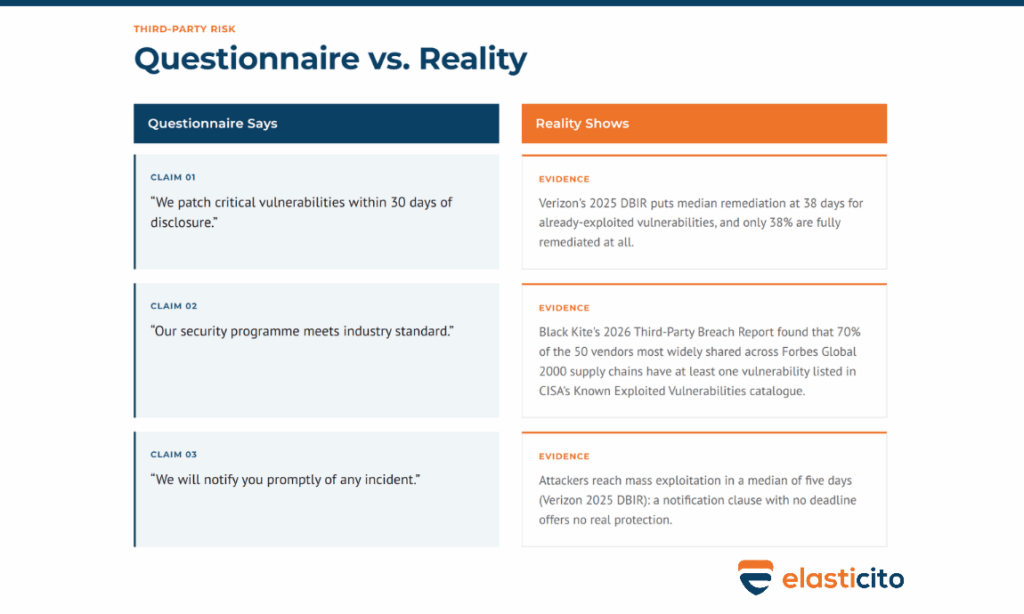
How does a contract gap turn into insurer-alleged negligence?
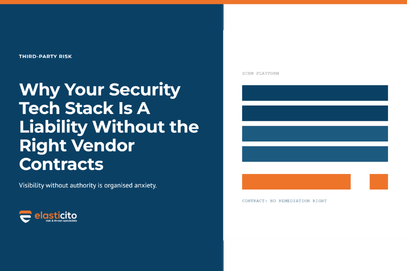
A contract gap becomes negligence in the insurer’s eyes the moment visibility and authority stop matching each other. Securing the supply chain is not solely an IT function; it is a financial and fiduciary responsibility that sits with the board, because the costs land on the balance sheet.
Regulators are converging on the same expectation from a different direction. Frameworks built around continuous third-party oversight – rather than point-in-time attestations – are becoming the compliance baseline organisations are measured against after an incident, regardless of what their insurance policy says. A contract that cannot compel remediation fails both tests at once: it weakens the insurance claim and it weakens the regulatory defence.
What should supply chain contracts require to protect your coverage?
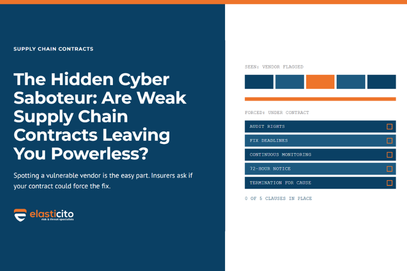
Contracts written for the old questionnaire-based model rarely hold up under this test. Five clauses close the gap between what your SCRM tools can see and what your contract can actually force:
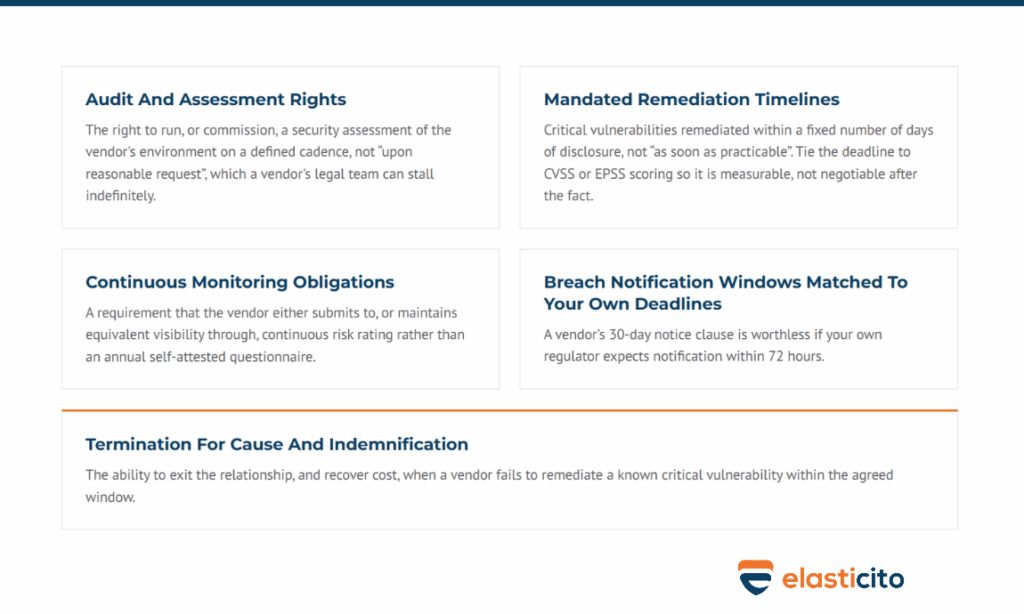
None of these clauses require exotic legal drafting. What they require is treating the contract as the enforcement mechanism for the risk data you are already collecting – because an insurer will eventually ask to see both side by side.
Conclusion: why contractual authority, not just visibility, keeps cyber insurance valid
Spotting a vulnerable vendor is no longer the hard part; forcing them to fix it, on a timeline your contract can prove, is what keeps a claim from being denied. Register for the upcoming webinar, Are Your Vendor Contracts Secretly Sabotaging Your Cybersecurity?, to check whether your contracts meet the standard insurers now enforce.
Frequently asked questions
Does cyber insurance cover breaches caused by a vendor?
Most standard cyber insurance policies do not automatically cover downstream losses from a vendor or cloud partner’s breach. Vendor breach exclusions are a distinct coverage gap that typically requires a specific endorsement or rider, and insurers increasingly test whether the policyholder had contractual authority to prevent the vendor incident before honouring a claim that touches one.
What is a supply chain risk management (SCRM) clause?
An SCRM clause is contract language that gives an organisation ongoing authority over a vendor’s security posture – audit rights, remediation deadlines, monitoring obligations, and termination rights – rather than a one-time attestation at signing. It is the enforcement counterpart to whatever risk-rating or monitoring tool detects the vendor’s exposure.
Can an insurer deny a claim because of a vendor’s negligence?
Yes. If an insurer can show the policyholder knew, or should have known, that a vendor was vulnerable and had no way to compel a fix, that combination supports a negligence argument even though the vendor caused the breach. The policyholder’s own contractual inaction becomes the basis for the denial.
What contractual rights protect cyber insurance coverage?
Audit and assessment rights, remediation timelines tied to vulnerability severity, continuous monitoring obligations, notification windows that match the policyholder’s own regulatory deadlines, and termination-for-cause with indemnification are the clauses insurers and their claims investigators look for when assessing whether a policyholder managed a known third-party risk.
How often should vendor contracts be reviewed for cyber insurance compliance?
Critical and high-risk vendor contracts warrant review at least annually, and whenever a vendor’s risk rating changes materially, a renewal is negotiated, or the organisation’s own insurance policy is renewed and its underwriting requirements change. Waiting for a scheduled multi-year review leaves the contract gap in place through several policy cycles.